

Bits from a Podcast About Judy Garland
Background
Not long ago I discovered bits from a podcast script, as I looked for a certain way I closed out a show.
Opening the script for the 5th episode of a series that examines all sides and merits of The Judy Garland Show (1963-64), I re-read these words and feel really good about them.
This was a working script that refers to audio clips that need to be stitched into the larger audio, thus creating the final version. In this case, most of those clips are from a fun, memorable conversation recorded in-studio with Angela Ingersoll.
Transcript Excerpt
Listeners,– that was Judy Garland and her guest Lena Horne. We’re devoting 5 podcast episodes to The Judy Garland Show, which ran from 1963 to 1964 – 26 episodes. Why you ask? Well so do we! What IS the series place in TV Herstory?
Dozens of books and documentaries about Judy Garland – they fairly consistently recount facts. Over the years, they’ve drawn in first hand accounts of people who had worked with her, many whose careers started with her, on the MGM lot in the late 30s. Certainly, when a person – a woman – becomes an American legend at the age of 16, she lives a life bound to be documented by those around her.
In life and death, Judy’s star is surrounded by men. In life, there were husbands, agents, close musical colleagues – arrangers, composers. There was Mickey Rooney and JFK. In death, there have been the legions of biographers and documentarians, husband Sid Luft meticulously re-packaging The Judy Garland Show for DVD release so it can remain an American treasure and — gay men the world over, who have a special affinity for Judy.
Where Are the Women?
Where ARE the women? Women certainly shared the stage with her, Lena Horne, Ethel Merman, Barbra Streisand, Diahann Carroll, Judy’s daughters Liza and Lorna. The question is important because 50 years later, American women likely still THINK they have little in common with Judy. It’s not like they hate her, they just don’t love her. Hmmm, Does that sound vaguely 2016?
What’s NOT to like about the story of a woman who battled addiction yet managed to become one of the most talented American performers of all time? I think rooted in these questions, which require an understanding of generations and the herstory of feminism, is a default observation made by so many – that for so many years, American women – white women – have been hard pressed to outrightly support other women. And maybe there are some who are easier to support – Katharine Hepburn because she wore pants and wasn’t overtly sexual, Dinah Shore because she was so friendly and could sing (but wasn’t too showy, she wasn’t a belter like Judy) or more recently, Oprah. Because she’s Oprah.
Judy’s Own Words
And then there’s the fact that Judy’s on record – remember, her every move had been monitored by studios and movie magazines since she was 15 – as having written “In the obscure recesses of their hearts, all women realize – ‘know, know, know’ that the male must lead, the female must follow.” Was this really her statement? How old was she when she wrote it? Did someone ghostwrite if for her – possibly a man?
It’s quoted in biographer Gerald Clarke’s Get Happy, from 2000. Page 375. To his credit, Clarke’s analysis found the quote to be a bit ironic, given that it had long been men, at every turn, who had let her down, left her, stolen from her…
I cannot cite that quote’s origin, but if it was attached to her in 1962 and ‘63, it would explain why men expected her to behave and why her own interest in finally OWNING her work – not just collecting a check – may have seemed a passing fancy to them. She maybe should have been more bold in her pronouncement of wanting creative control of her show and her life.
Oh my gosh! This is not a topic for a novice or dreamer!
Chat with Angela Ingersoll
So listeners it was fascinating to encounter recently Angela Ingersoll – right here in Chicago. Angela’s developed a one-woman plus orchestra show that tells Judy’s story and sings her songs. The Judy Garland Show, which ran 1963-64 for 26 episodes, had long been on my list of projects.
Women 2
It’s going to take a lot more storytelling and pouring over research – by women, and even mining the feminist consciousness of daughters Liza and Lorna for there to be greater understanding of how Judy Garland’s TV series influence TV and women.
So even when we tell the story of how the series made it to TV, it has a different level of energy coming from a woman…
Concert
Only in the last few years have we really come to know Hollywood’s darkest secrets about ageism, racism and sexism. Pick a headline, pick a statistic and re-write any woman’s life story if a power play had never been used against her. And more realistically, not just a woman’s but a person of color’s career as well.
It’s clear from the research that Judy leveraged her own power. She understood the power of representation and how there were few like her on TV in their mid-40s.
Dinah!
Ageism
Self-deprecation that she thought ensured survival – The Judy Garland Show nonetheless boasted a solid guest line-up. American culture and society, the early 60s!
60s
Judy’s Guests
To be a guest on Judy’s show required vocal talent above all else, at a time when orchestral music had given way to guitars, drums and an occasional horn or bass. Guests had to fit into Judy’s style or at least complement it. Ed Sullivan, the show that preceded her time slot that year, could be more adventurous because it didn’t revolve around Ed’s singing talent.
So long as The Judy Garland Show’s format remained unsettled, the best Judy and her orchestra could do would be to serve as a transitional stage of American music. Out with the old and in with some of the new.
Judy’s Family Life
Having come to this place along very different paths, Angela and I have consumed much of the same Judy biographical material. As a much more public face of Judy’s music and style, however, Angela has collected hundreds of personal stories from audience members around the world.
Joey & show
See a clip of Angela and Joey, from the Mother’s Day Tribute, on YouTube.
Make no mistake, from a feminist perspective, this feels in hindsight like a really tough, tough lesson about show biz’s cutthroat nature. Judy Garland’s talent was mismanaged from her teenage years. Addicted to stimulants and depressants to keep her performing on little sleep, that condition made her more vulnerable in ways we can only imagine. But there were a few victories in a year, where otherwise it appears CBS let her down at every turn, seemingly wanting her to fail.
Judy and JFK
So for us to truly understand an extraordinary piece of TV herstory – story and video combined – Angela and I revisited Judy’s relationship with John F. Kennedy.
Lawford
In his book, The Judy Garland Show: Rainbow’s End, researcher Coyne Steven Sanders interviewed nearly every living show crew member. A number of higher ups in production, writing and direction guided him through the many details of the 26 episodes, delivering shared memories which can leave you with the strong impression this really happened.
Judy did in fact have the capacity to get a direct phone call into the president.
They would talk.
She would sometime sing to him on the phone.
Nov. 1963
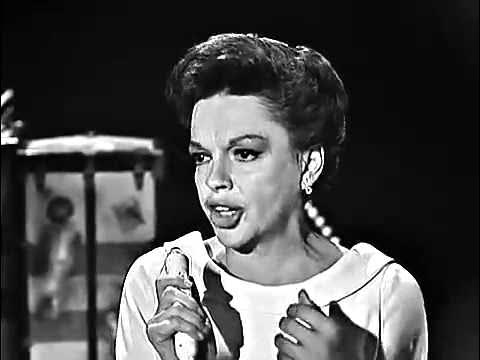
She planned to close the show to be taped on December 11th with The Battle Hymn of the Republic. From all reports, the week, with America was still in mourning, was a difficult one for Judy. By extension, it was tough for everyone on the show, including Ethel Merman.
The Battle Hymn of the Republic
Listeners, Ethel Merman was considered the first lady of the American musical comedy stage. At 36 years older than Judy and many inches taller, but a force and a name as well known as Judy’s. Merman’s week of rehearsals went according to schedule, with nary a glimpse of Judy. Instead, there was a stand-in who enabled lighting, blocking and choreography to get planned.
Judy was tense and nervous all week – hmmm, was it handling the stressor moment of the nation in mourning? Having the legendary Ethel Merman on her show or maybe it was the nerves building up as she prepared to call a quarterback sneak in the form of The Battle Hymn of the Republic?
First Hand Account of TV History
Coyne S. Sanders’ book included rich reflections from key witnesses like executive producer Bill Colleran:
– – “The first time Judy sang it was at dress rehearsal. The first one. I think was even better, if that is possible, than the one that aired. That’s when, right before she sang it, she looked straight into the camera and said, ‘this is for you, Jack.’ It was a powerful moment in my life. I will not forget that for as long as I live. Never. There wasn’t a dry eye in the house. People on their knees crying. It was devastating. I was sobbing out loud. I’ve never been so moved in my life by anything, anybody or any drama. Nothing compared to what that did to me the first time she sang it. She gave every bit of her soul to that number. Everything that was Judy Garland was there and on the line at that moment, everything she had to give. “ – executive producer Colleran recounted.
– – “The final taping was an hour later. She felt so deeply, she knew what she had. She got a standing ovation. The audience was crying, they were so moved. When she came backstage, she was crying and I was crying. She was pleased at doing it for Jack. She knew what she had done. But she was very easy, very quiet. Everyone just quietly went home. I was handling her very carefully that night. She was very, very fragile. She had given so much. I can still see that little four foot eleven inch gal standing there, her head higher and higher, tears streaming down her face as she sang her heart out. It’s moments like this that make you forget your problems.”
A YouTube Artifact
Now that you know the story, find the clip on YouTube. Regardless of what country you call home, you’re sure to tingle when you hear her start out measured. Like maybe she was thinking CBS would pull the plug mid-song, and winds up strong. You see it in her body as well. And the tiny smile of satisfaction as she hits the homestretch – a real belter!
I had long considered myself pretty astute when it came to TV trivia, but why hadn’t anyone ever told me about Judy Garland’s rendition of The Battle Hymn of the Republic?
- Because the series didn’t air in reruns until only recently.
- Because variety shows tend to be overlooked for their historical and cultural value.
- Because singing the song, while lauded, was an action not sanctioned by CBS executives. Bet your bottom dollar they weren’t going to promote this — ever. She went around their backs.
- Because the whole effort and sentiment was woefully misunderstood. Only recently – perhaps now that social media has made us more connected – do we understand how important it is for public mourning.
Variety Shows
When you think about it, when done right, variety show offer us layers of cultural significance. The Cher Show or the Sonny and Cher Show, fresh and fascinating! Carol Burnett’s variety show made her a TV icon in her own right – putting a woman’s face on comedy for 279 episodes. But Carol didn’t bring 30 years of show business and awards and best-selling records to her first day on the set.
And Andy Williams, Dean Martin and the countless other variety shows hosted by men Well they don’t include the herstoric legend of disregarding network directions and belting out a national hymn, with many of those executives right in the audience!
Listeners, that’s the answer. What role does The Judy Garland Show have in TV Herstory? It’s a wobbly American bridge – an important visual transition for a country facing an increasingly accelerated pace of change. It balanced America’s music standards with new faces and sounds. It leveraged old time stars but packaged Judy in a sophisticated wardrobe as stage leader of comic sketches and musical gold. Its writing was often miserable, but everyone was grateful for the opportunity to work together.
It’s a series for scholars and people who want to better understand the entertainment industry at its best and worst – all wrapped up in one show.